The Library of Alexandria is the most valuable card I’ve ever worked on. Here’s what that commission taught me about trust — and what it really means to transform something irreplaceable.
Some cards carry several forms of value at once: they’re rare, they have a price, and they have a history. The Library of Alexandria — Arabian Nights (1993) — is one of those.
It’s the most valuable card I’ve worked on to date. Commissions like this is a magical and extraordinary moment.
What drew me to altering in the first place wasn’t the market value of cards. It was the desire to bring them to life. I bring the same attention to every project, whether the card is worth €1,200 or a few cents. Some collectors want to enhance an investment; others simply want to give new life to a card that means something to them. Both intentions deserve the same care.
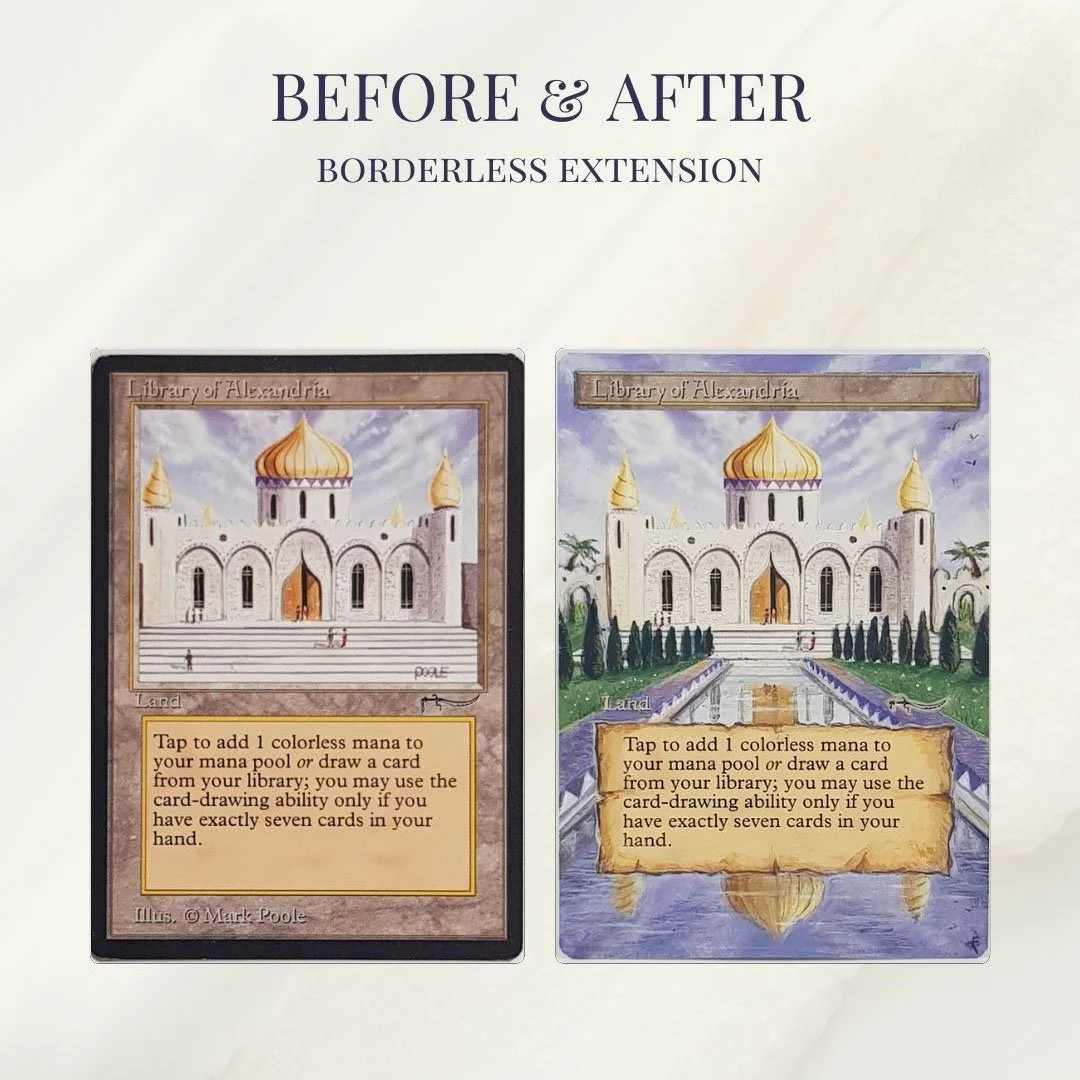
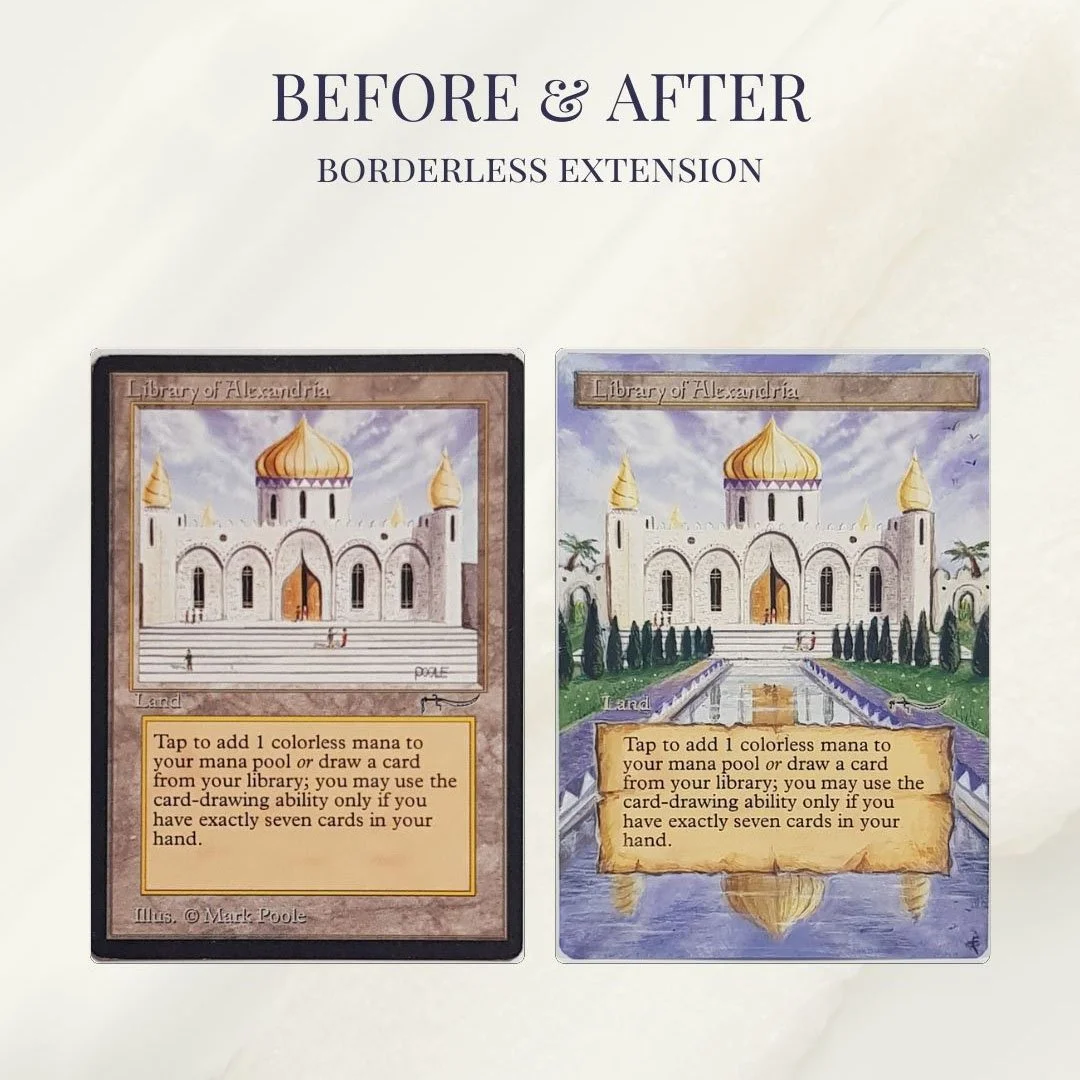
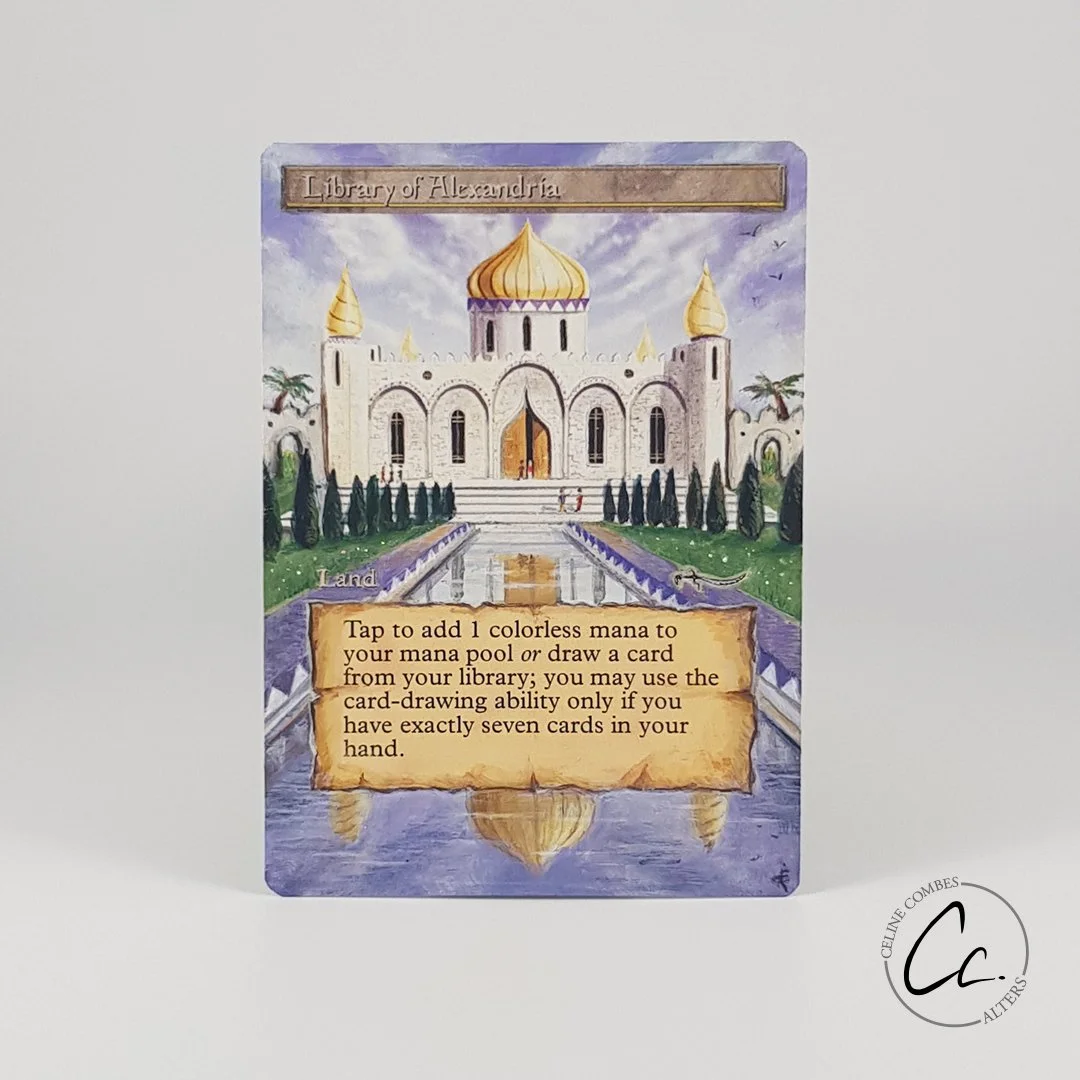
Borderless extension of the card, hand-painted by Céline Combes
A €1,200 card — and what the numbers don’t tell you
The card arrived at my studio in a small parcel sent from Monaco. I knew it had value, but I didn’t know the exact figure — it was only at the end, when insuring the package for return shipping, that I asked for a purchase receipt as documentation. That’s when I found out: around €1,200.
What mattered most was something else entirely. The collector was trusting me not only to handle something irreplaceable, but to get it right. Those two things aren’t quite the same.
Before starting, I cut out all distractions. Soft classical music. The first strokes were the hardest — tentative, searching for footing on unfamiliar ground. Then, gradually, the card began to transform under the brush. I found my way in, and started composing in real dialogue with the original illustration.
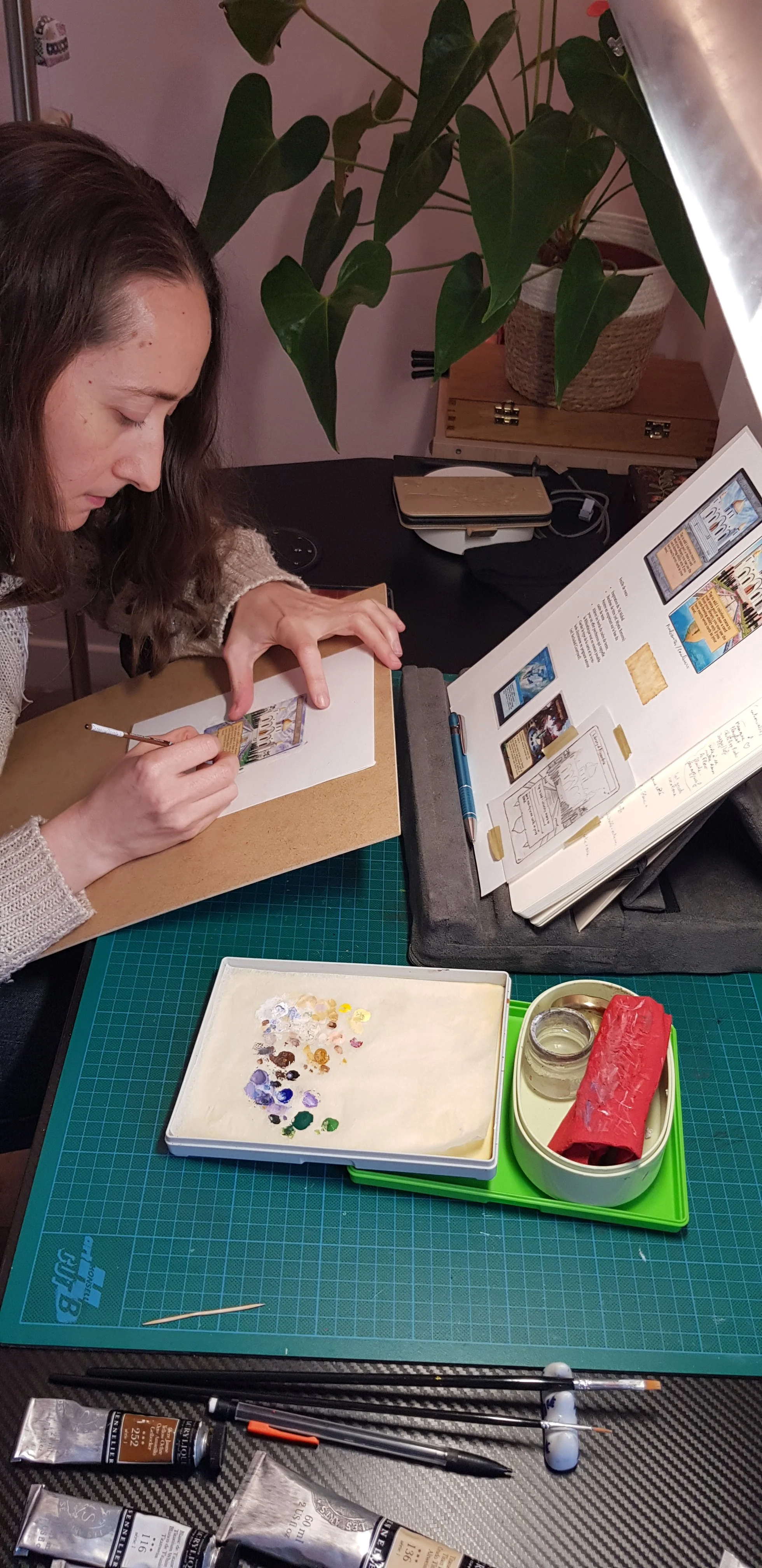
Deep in concentration — studio photo
Sending a valuable card: what it looks like in practice
For many collectors, the real hesitation isn’t the alteration itself. It’s the shipping.
Within Europe, sending a card with declared value and tracking is straightforward to arrange. For collectors outside Europe — particularly in the US — I’d advise against shipping a card of this value internationally. The cost and logistical risk simply aren’t reasonable. The most practical solution is to purchase the card on Cardmarket from a European seller, who can ship it directly to my studio. That way, you avoid a transatlantic round trip for something precious. For those based nearby or passing through the South of France, hand delivery is also possible by appointment.
Every commission is handled according to its value, its history, and its destination. When working with something this significant, nothing is left to chance.
Honoring the spirit of Arabian Nights
The goal wasn’t to transform this card into something else entirely.
Arabian Nights evokes distant lands, warmth, a particular sense of knowledge and mystery. The collector wasn’t looking for a dramatic effect. He was looking for something that extended what was already there.
I designed a borderless extension inspired by the gardens of the Taj Mahal: still water, delicate architecture. A way of opening the original illustration without forcing it.
The work of acrylic altering
Painting an extension isn’t about filling an empty space. You’re working in continuity with what already exists.
The light, the colors, the atmosphere must stay coherent with the original illustration. I build up the acrylic layers gradually, aiming for the edges of the extension to blend naturally into the landscape. Depending on what we’ve discussed, touches of gold leaf or metallic paint can also be added at this stage.
What the collector said
When Alexandre received the card, he wrote:
“The card is superb — exactly as it should have been printed in 1994 (…) I feel the atmosphere of the card and the ARN series has been very well preserved, while adding another dimension with the gardens and the fountain, which makes me want to visit this library — it feels far more inviting than the original card.”
The rarity doesn’t disappear
Before the alteration, it was a rare card valued at €1,200. After, it’s a hand-painted unique piece — the only one of its kind in the world.
There’s a lot of debate about whether altered cards lose value. I explore that question in a dedicated article, if you’d like to dig into it.
Many wonder if altered cards lose value. I explore this in depth in my dedicated article on altered card value.Trust as raw material
Trust as the starting point
In this work, the raw material isn’t just paint. It’s also the trust a collector places in the process, in the communication, and in the care given to every step.
Iconic cards demand real discipline. You’re not there to express yourself at the card’s expense. You’re there to give it more space.
Are you considering a commission on a valuable card?
Whatever the card — old, rare, or simply close to your heart — the same principles apply: start by respecting what’s already there, then think together about what we can bring to it.
You may contact me to discuss your project, or review the commission process here.
More articles about MTG Altered Art