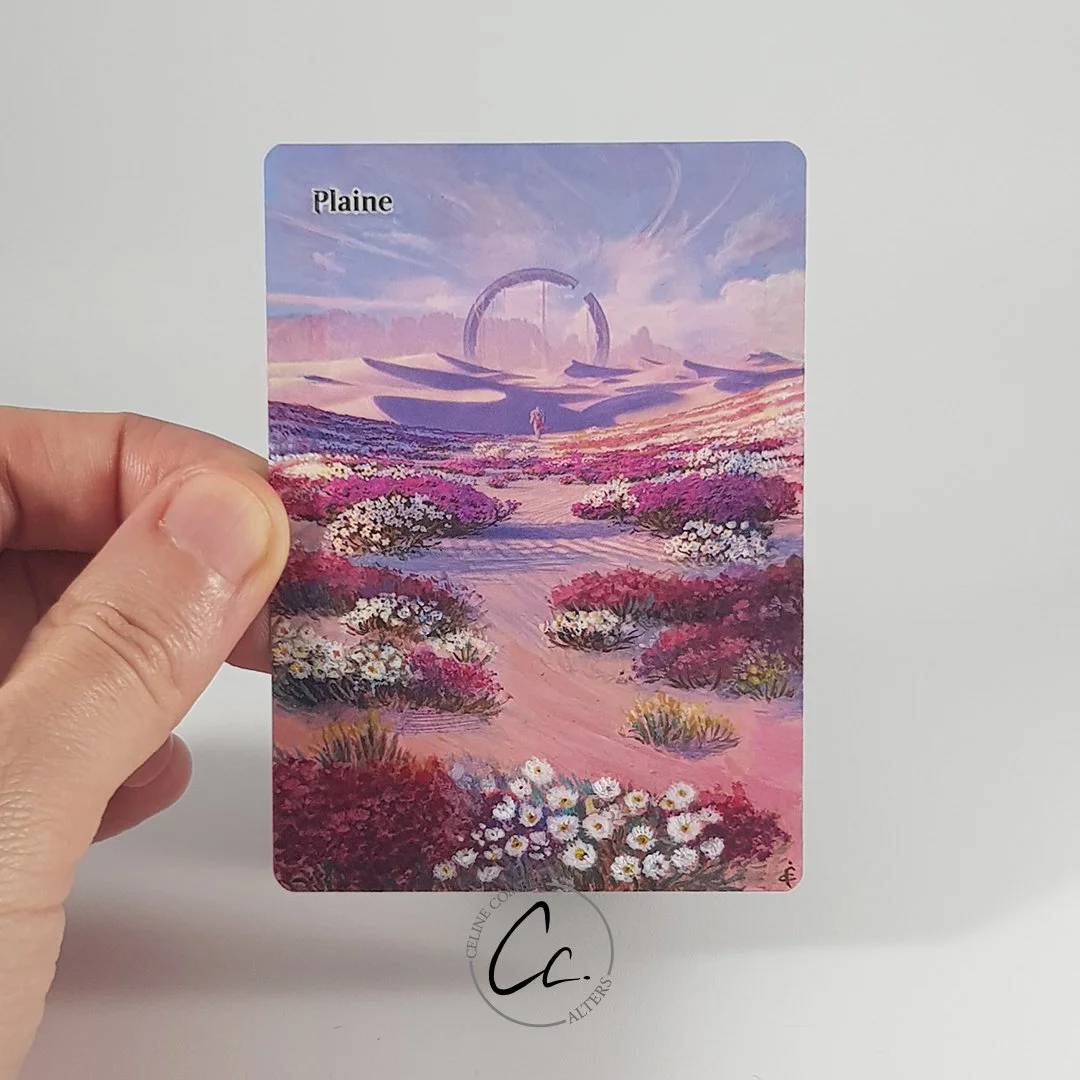
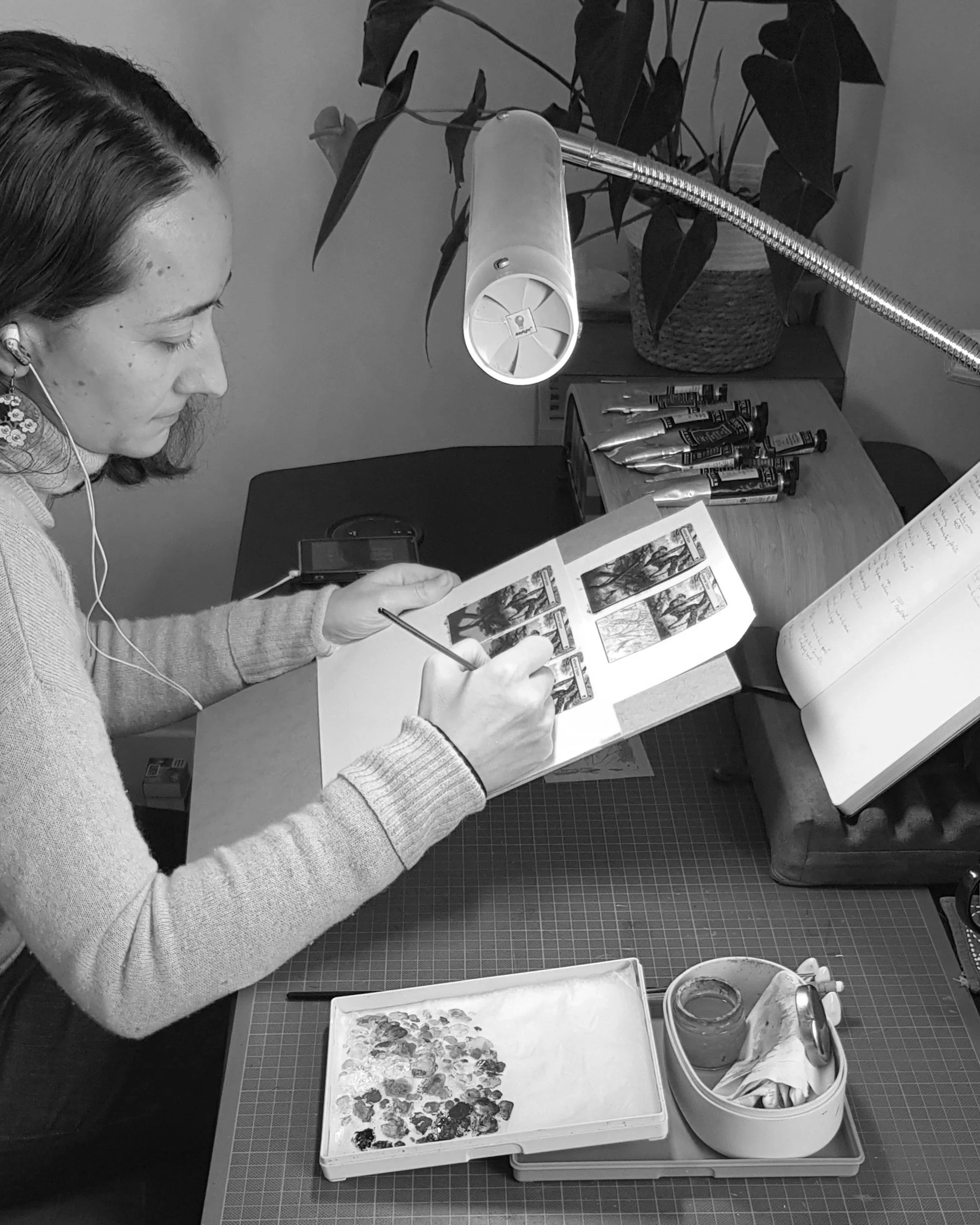
When I started doing alters, I said yes to almost everything. The demand was there, the desire to learn too, and I hadn't yet figured out what actually worked for me.
One day, someone asked me to replace a Magic card's character with a woman. With each exchange, the brief got more specific, then more specific again. The details multiplied : the shape of the pupils, a tattoo in a precise spot, the exact angle of the face. I followed the brief and delivered the card.
The response came back : the woman looked too old.
I scraped the paint off the face and started over.
The second version wasn't right either. I asked : what feels too old to you? What would make her look younger? The answer came as an image : they edited a photo of the card in Photoshop and sent it to me, eyebrows raised, mouth repositioned. But I don't work on a file. I work on a card, with a brush, across a few centimetres of surface, sometimes just millimetres for fine details. Photoshop and a brush on a playing card are not the same tool.
The same limit applies to AI-generated images. They can suggest an idea, a direction, an atmosphere. But the result at actual size, with my hand and my approach, will never be an exact reflection of what an AI produces. They are two different languages.
I'm not inside your head. However close I get to what you're envisioning, I cannot reproduce something that only you can see.
What was actually happening
It wasn't a skill problem, it was a dynamic.
At some point in that exchange, I stopped being the artist. I had become someone else's hand, working towards an image that existed in their mind and that I couldn't see. Each new request seemed reasonable on its own. But by the end, I looked at what I'd painted and didn't recognise myself in it.
When a commission drifts too far from what I do, it throws me off. That's a cost most people don't see, but it's real.
An example that worked
A client wrote to me with pages of references, specific artists, detailed ideas about what he wanted. It was a lot. But he never imposed his choices. He suggested, he listened to what I told him was achievable. At the end he wrote that he had appreciated the way I welcomed ideas.
It's not a dense brief that's the problem. It's when the brief leaves no room for me.
Another client wrote with pages of references, specific artists, detailed ideas about what he wanted. It was a lot. But at no point did he take the pencil out of my hands. He suggested, he adapted to what I told him was possible, he trusted me to find a way. At the end he told me he appreciated the way I welcomed ideas.
What matters is the space the requests leave, not how many there are.

Jeleva, Nephalia's Scourge — Borderless extension with gold leaf details © Céline Combes Alters
The question I ask myself now
Painting small faces is hard, proportions are tight, a single line changes an entire expression, and the expectation of likeness leaves little room. But that's not the whole truth. Those experiences pulled me away from portraits, and for a long time I gave the technical reason without saying the other one : that I had lost the desire, that it had left a mark on me.
Now I work on landscapes, imaginary worlds, extensions. That's where I find myself.
I've learned to recognise the moment when I'm no longer really present in what I'm painting, when what I'm being asked to do is no longer my work. I can feel it early enough now to stop.
Someone gives me a card, a universe, sometimes a few references, and I interpret it in my own way. The result often surprises them. That's exactly what I'm after.
This interpretation takes very different forms depending on the project. On Elephant Graveyard, I transformed the whole atmosphere. On Yavimaya Hollow, the work was more discreet, almost invisible. I talk about it this in this article).